


AI is no longer an emerging concept in physical security. It's already being used to analyze video feeds, detect unusual access activity, reduce false alarms, automate operational tasks, and help security teams respond faster to incidents.
Rather than replacing human operators, most modern AI systems are designed to surface patterns, prioritize alerts, and provide context that helps people make better decisions. Here's a look at how AI is changing physical security systems today and where the technology continues to evolve.

How Can Artificial Intelligence Make Physical Access Protocols More Secure? #
With the rapid advance of technology, the integration of AI and physical security will continue, making access protocols more secure. Here's what to expect:
1. Video Surveillance Analytics #
Typical video surveillance systems can only analyze a crime after it's been committed. There may be enough cameras scattered around your desired area, but not enough people to watch video feeds and scan content.
Deep-learning AI has helped overcome this limitation. The software analyzes footage and detects anomalies (e.g. indicators of violent behavior) in real-time. AI can prevent criminal acts and allow for a quick reaction when they occur.
Modern video analytics go further than simple motion detection. Today's systems can identify specific incident types like a person entering a restricted area, an object left unattended, a crowd forming too quickly, and alert operators before a situation escalates.
False alarm rates, historically one of the biggest frustrations with AI-assisted surveillance, have dropped significantly as models have improved. Some platforms now let security teams search footage using plain language queries rather than scrubbing through hours of recordings manually.
The result is fewer people watching screens passively, and the people who are watching can focus on verified alerts that actually need attention.

Improve visibility across every entry point
Monitor activity and investigate incidents with greater confidence.
2. Access Control Systems #
Intelligent access control systems are an all-inclusive solution to physical security. The software takes advantage of automation to monitor your facility, protect sensitive data and diagnose problems. If an issue or vulnerability is found, solutions are recommended.
An access control system allows you to utilize multiple components and failure points, similar to video surveillance. It can alert human personnel to security issues while tracking system uptime.
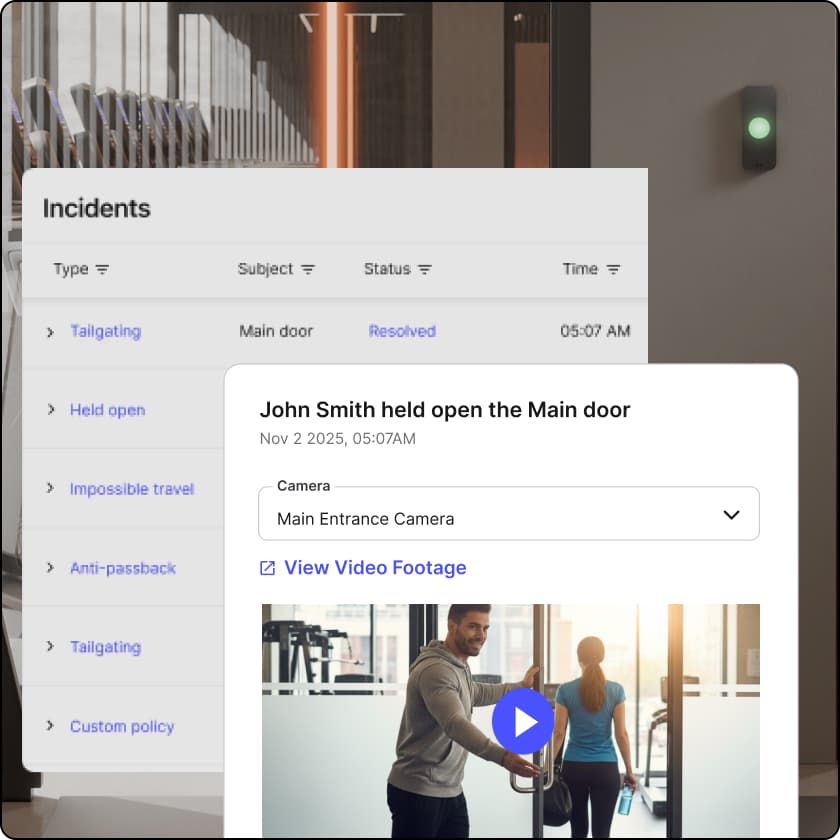
Where AI adds a meaningful layer is in anomaly detection. Rather than relying on manually configured rules, AI-powered access control can learn normal patterns of behavior (who accesses which areas, at what times, how often) and flag deviations automatically.
A credential used in two locations within minutes, an access attempt at an unusual hour, or a tailgating event at a controlled entry point can all be surfaced without a human having to spot it first.
This shifts access control from a passive log of what happened to an active layer of security that responds in real time.
3. Robot and Drone Patrol #
Before the advent of AI, physical security called for human law enforcers. Security personnel patrol the streets and look for potential threats. An understaffed team and lack of equipment can lead to gaps in safety.
Autonomous patrol has moved from concept to deployment in specific contexts. Warehouses, large campuses, parking structures, and critical infrastructure sites are using wheeled robots and drones to cover ground that would otherwise require multiple security officers.
These systems don't replace human staff, but really extend coverage into areas or hours where maintaining a full patrol isn't practical. When something is flagged, a human operator reviews and responds.
4. Automation of Tasks #
AI is already helping the security sector by automating repetitive tasks, allowing organizations to reallocate human staff. AI can "watch" hundreds of hours of video in a matter of seconds. It also can distinguish between different videos, ideal if looking for a specific person.
Security teams spend a significant amount of time on tasks that aren't monitoring: writing incident reports, reviewing logs, triaging alerts, briefing the next shift. Agentic AI tools (which are systems that can act on instructions across multiple platforms) are starting to handle these tasks.
A system can automatically generate an incident summary from access logs and camera timestamps, route an alert to the right person, or flag a pattern across multiple sites without a human having to pull the data together manually.
As these systems mature, repetitive monitoring tasks are increasingly handled end-to-end, freeing human staff to focus on work that requires judgment rather than just observation.
5. Crowd Monitoring #
Monitoring a large crowd (like a busy street, metro station, shopping area or concert) can be difficult, especially with a limited workforce. Tracking each individual's activity and behavior would be nearly impossible.
AI crowd monitoring systems can analyze occupancy levels, movement patterns, and crowd flow across a designated area. Smart sensors can detect objects made with specific materials and discern their shape, even when hidden from sight. Human personnel are alerted if a weapon is discovered.
Beyond crowd counting, newer sensor technologies (including LiDAR) add depth and accuracy that cameras alone can't match. LiDAR can detect objects and movement even in low light or through visual obstructions, and it's becoming more common in high-security environments like data centers, transit hubs, and warehouses.
Behavioral analysis has also improved and instead of just tracking where people are, systems can flag when movement patterns suggest something is off (let’s say, people moving against crowd flow, lingering in restricted zones, or gathering in ways that precede incidents).
6. Decision-Making Capabilities #
AI is now actively used by security professionals to make faster, better-informed decisions. Systems can correlate events, flag anomalies, and surface relevant context before a situation escalates, reducing response time and helping teams distinguish real threats from false alarms.
With AI, professionals can determine which events require a call to law enforcement and which are false alarms. This capability, once limited to early prototypes, is now in active deployment across security operations centers worldwide, with measurable improvements to incident response rates.
The more recent development is AI that doesn't just flag events, but helps operators understand them. When an alert fires, a modern system can pull up the relevant access history, related camera footage, and similar past incidents automatically, before a human has to go looking.
Natural language interfaces take this further, letting operators ask questions of their security systems the way they'd ask a colleague. The goal isn't to remove humans from the loop, but to make sure that when a decision needs to be made, the person making it has the right information in front of them.

The Future of AI in Physical Security #
AI is no longer a future concept in physical security. It's already changing how organizations monitor facilities, respond to incidents, manage access, and reduce operational blind spots.
As Thomasina Martin, enterprise account manager at Genetec, noted while discussing the evolution of AI in physical security, “AI is doing more of the heavy lifting related to physical security, allowing human operators to focus on decision-making.”
At the same time, the growth of AI-driven surveillance and monitoring systems continues to raise important questions around privacy, accountability, transparency, and human oversight. As these systems become more capable, organizations will increasingly need to balance operational efficiency with responsible deployment practices.
The future of AI in physical security will likely depend not just on how advanced the technology becomes, but on how effectively the industry builds trust around how it's used.
Kayla Matthews writes about AI, cybersecurity and data privacy for Security Boulevard, Information Age, Security Magazine and Malwarebytes. To read more from Kayla, visit her blog, Productivity Bytes.

Could AI help your security team do more with less?
Discover how organizations are using AI to improve security outcomes and operational efficiency.

Guest Post
Guest Writer